Inspired by water, made for pool—Professional pool product manufacturer since 1992
astrowavecn@gmail.com +86 15976410611


Views: 0 Author: Site Editor Publish Time: 2026-11-23 Origin: Site
A swimming pool pump and filter work as one system. The pump moves water; the filter removes what the water carries. When the two are matched in capacity and maintained on a regular schedule, the water stays clear with less chemical adjustment and less wasted energy.
A residential setup should turn over the entire water volume at least once every 24 hours. That turnover rate is the starting point for sizing both parts of the system: a pump too small leaves water under-filtered, and a pump too large wastes electricity and strains the plumbing.
The pump is the driving force. It pulls water from the skimmers and main drains and pushes it toward the filter tank. Inside the tank, the water passes through a bed of media that traps dirt, body oils, and organic matter. Clean water then leaves the tank and returns to the pool through the return jets.
Continuous movement matters for more than clarity. Circulating water distributes sanitizing chemicals evenly through the whole basin. When water stands still, contaminants multiply and the water turns cloudy.
Size the system from the pool volume, not from the pump alone. A full water turnover every 6 to 8 hours is generally adequate for a residential pool. The pump flow rate must stay within the maximum flow capacity of the filter tank: an oversized pump pushes water through the media too fast and can damage the tank and plumbing, while an undersized pump cannot keep up with the filtration load.
Pumps come in single-speed, dual-speed, and variable-speed models. A variable-speed pump adjusts its speed to the task at hand, which lowers energy use when full flow is not needed. For most residential pools, running the pump 8 to 12 hours a day is enough to complete the daily turnover. A variable-speed pump can run at a lower speed for 24 hours a day, which keeps filtration continuous while using less total electricity.
The filter tank holds the media that does the actual trapping. Three types cover most residential and light commercial pools. The table below compares them on the points pool owners usually check first.
| Media Type | Maintenance Frequency | Particulate Capture Size | Typical Lifespan |
|---|---|---|---|
| Cartridge elements | Clean every 2 to 4 weeks | 10 to 20 microns | 1 to 2 years |
| Granular silica sand | Backwash when pressure rises | 20 to 40 microns | 3 to 5 years |
| Diatomaceous earth (DE) | Monthly backwash | 3 to 5 microns | Powder added frequently |
Choose cartridge elements if local rules restrict backwashing or if saving water matters. Choose granular silica sand for the simplest routine with the least daily attention. Choose diatomaceous earth when the pool needs the finest filtration and frequent maintenance is acceptable.
The filter in this setup is a sand filter: a pressurized tank filled with silica sand. The VTL Series fiberglass sand filter is built for that role. Its gel-coated fiberglass tank holds the media bed, and a side-mount multiport valve controls filtering, backwashing, and rinsing. A 30 mm clear-view lid on top lets the media bed be checked without opening the tank, and a top-mounted pressure gauge shows when the media is loading up with dirt.
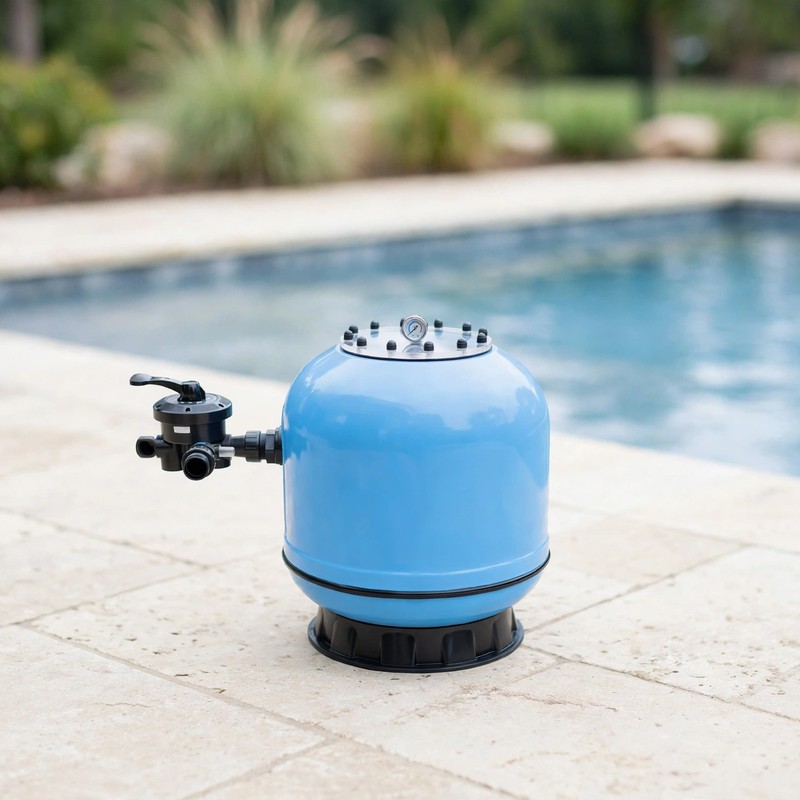
The VTL Series comes in four sizes. Diameter, maximum flow rate, and sand load for each model are listed below. Match the pump to the model in use: the pump flow rate should not exceed the maximum flow rate of the filter.
| Model | Filter Diameter | Maximum Flow Rate | Sand Load |
|---|---|---|---|
| VTL525 | 525 mm | 12 m³/h | 88 kg |
| VTL650 | 650 mm | 17 m³/h | 158 kg |
| VTL750 | 750 mm | 22 m³/h | 260 kg |
| VTL900 | 900 mm | 32 m³/h | 422 kg |
The fiberglass sand filter is the filtration half of the setup, not a complete pump-and-filter set. The pump is selected separately and matched to the filter model and the pool volume. Its maximum working pressure is 2.5 bar (36 psi), with a factory test pressure of 4.0 bar, and it suits filter media sized 0.5 to 0.8 mm.
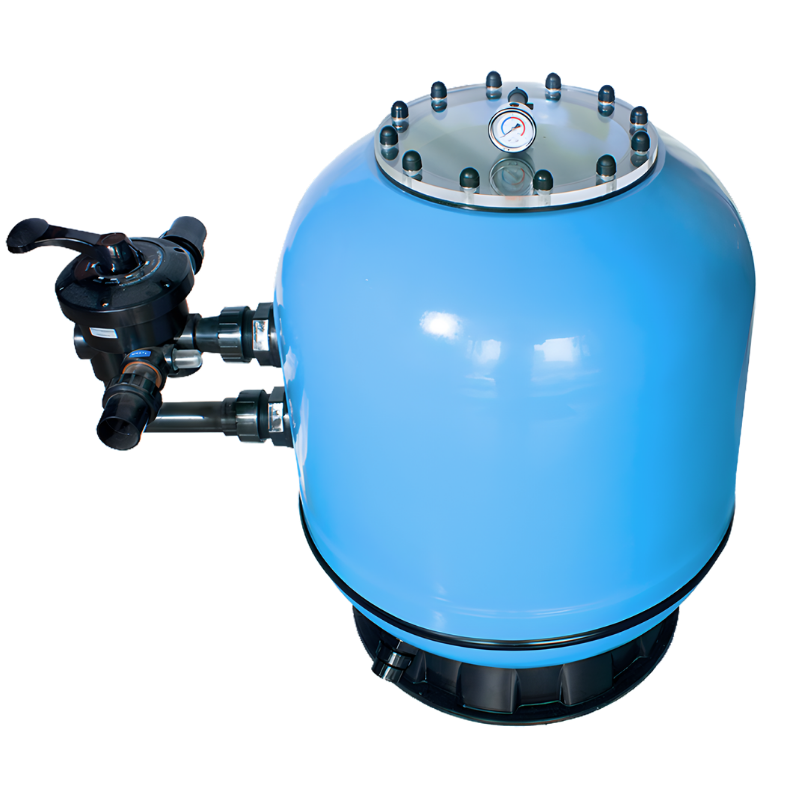
Valve connections are 1.5 inch (50 mm) on the VTL525 and VTL650, and 2 inch (63 mm) on the VTL750 and VTL900. Total height runs from 730 mm on the VTL525 to 1080 mm on the VTL900. The VTL Series sand filter fits residential pools and light commercial installations where steady particle removal is required.
As dirt builds up in the sand bed, pressure inside the tank rises. Backwashing reverses the water flow and flushes the trapped debris out through the waste line. The steps are:
Turn off the pump, move the multiport valve to the Backwash position, and turn the pump back on. Let the water run out the waste line for two to three minutes, until the water in the sight glass runs clear. Turn off the pump, set the valve to Rinse for 30 seconds, then return the valve to the Filter position.
Check the pressure gauge as part of the routine. A high reading means water cannot pass through the tank easily, which usually points to media clogged with dirt and debris. Backwash first. If the pressure stays high after cleaning, check for a blockage in the return lines or for media that is fully exhausted.
Replace the silica sand every three to five years. Over time, the sharp edges of the grains wear smooth from constant water friction, which reduces their ability to trap small particles. If cloudy water returns to the pool even after a thorough backwash, the media is likely due for replacement.
Run the equipment long enough to turn over the entire volume of water at least once a day. For most residential pools, this takes 8 to 12 hours of pump run time. A variable-speed pump can run at a lower speed for 24 hours a day, which provides continuous filtration while using less total electricity.
Backwash it. Turn off the pump, move the multiport valve to Backwash, and run the pump for two to three minutes until the water in the sight glass runs clear. Then turn off the pump, set the valve to Rinse for 30 seconds, and return the valve to the Filter position.
Replace granular silica media every three to five years. The grains lose their sharp edges over time, which reduces their ability to trap small particles. Cloudy water returning to the pool after a thorough backwash is a sign the media is due for replacement.
A high pressure reading means water cannot pass through the tank easily. The media is usually clogged with dirt and debris. Backwash right away. If the pressure stays high after cleaning, there may be a blockage in the return lines, or the media may be fully exhausted and need replacement.
Click to Contact Astrowave Poolor Email us: astrowavecn@gmail.com


